CONCEPT NOTE
Background and Rationale
In commemoration of the fiftieth anniversary of the Organisation of African Union/African Union (OAU/AU), steps were taken to develop and produce the African Union’s Agenda 2063. The framework document outlines an approach to how the continent should effectively learn from past lessons, build on the progress already achieved and strategically exploit all possible opportunities available in the immediate and medium term, to ensure positive socioeconomic transformation within the next 50 years. The framework document aims to motivate policy change on the continent to have a transformed, prosperous and integrated continent by 2063.
As part of this initiative, conducting regular, systematic projections of the impact of significant regional and global trends on Africa—and Africa’s influence on the global stage—aligns with the AU’s commitment to anticipating and addressing emerging challenges shaped by globalisation, economic restructuring, technological and organisational shifts, and demographic changes. These efforts also resonate with the African Development Bank’s recognition that economic modelling is a crucial capability for understanding economic dynamics and supporting effective policy planning and implementation. The Bank has underscored the urgency of addressing training and capacity gaps in this area to foster comprehensive economic analysis and sound policy development.
At the same time, the importance of forward-looking assessments has been further emphasized with the release of the Second Ten-Year Implementation Plan of Agenda 2063, which outlines Africa’s ambitions for 2024 to 2033. These projections are critical for supporting informed decision-making and strategic planning, ensuring that African policies remain adaptive and responsive to dynamic global and regional landscapes.
To address the significant challenges outlined in the Second Ten-Year Implementation Plan (STYIP) of Agenda 2063, particularly the need for developing scenario planning and foresight analysis capabilities among Member States, this Concept Note proposes a comprehensive research and capacity-building project. This project will be hosted at the Gordon Institute of Business Science (GIBS) at the University of Pretoria. The project aims to capitalise on the partnership between GIBS and the Economic Modelling Academy (EMA) to deliver a specialised and impactful program to AUDA-NEPAD, enhancing the economic modelling skills and policy analysis capacity of Member States.
At GIBS, the Economic Modelling Academy (EMA) operates as a capacity-building organisation under its parent institution, Applied Development Research Solutions (ADRS), which specialises in research and economic model development. EMA’s courses in economic modelling are tailored specifically for executives and professionals involved in research, policy formulation, strategy development, and implementation. EMA adopts a non-technical and approachable instructional style, equipping participants with evidence-based tools for advanced analysis, forecasting, monitoring, and evaluation—skills that are essential for improving organisational performance and fostering economic development. EMA’s senior team has extensive experience in providing economic modelling training across Africa, including training teams from ten African countries as part of a UNU-WIDER economic modelling project.
Applied Development Research Solutions (ADRS), the parent organisation of EMA, is a South African institution that has specialised in economic modelling research services since 2004. ADRS has developed an extensive suite of macroeconomic, microeconomic, and integrated macro-micro models that are available through its website. These resources, including a comprehensive global macroeconomic model, are particularly well-suited for supporting the proposed project.
In 2014, ADRS led a project constructing future scenarios for African economies, aligning with the key milestones in the Africa 2063 Framework. Sponsored by the UN Economic Commission for Africa (UNECA), this project explored pathways for each African country to achieve an income status at least one level higher than its 2012 benchmark by 2033, corresponding to the objectives of the Second Ten-Year Implementation Plan (STYIP) under Moonshot 1. The final report from that project is provided for reference as an annexure.
Objectives
The latest report on Agenda 2030, titled “Decade of Accelerated Implementation,” emphasizes that “Continent-wide efforts should be made to develop scenario planning and analysis, as well as foresight analysis skills for Member States and other stakeholders to align and integrate the Ten-Year Plans into their development plans, budgets, and indicators.”
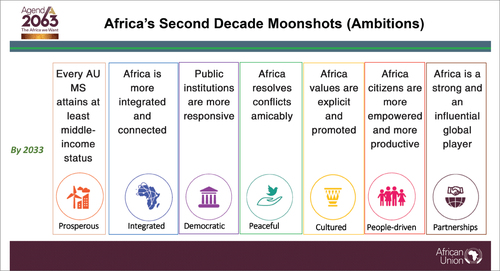
In parallel, three of the seven key ambitions for the Second Ten-Year Implementation Plan (STYIP), referred to as “Moonshots,” focus on the economic progress required by African countries over the next decade (2024-2033). These include achieving middle-income status for all African nations (Moonshot 1), fostering a more integrated and connected Africa (Moonshot 2), and enhancing the responsiveness of public institutions (Moonshot 3).
To support achieving these priorities, the objectives of this project are twofold:
- First, to utilise a comprehensive global economic model, that encompasses Africa and its regions, to quantitatively examine selected global and local economic scenarios that are particularly conducive to achieving Agenda 2063 goals related to Moonshots 1 and 2.
- Second, to leverage the EMA-GIBS executive programme in economic modeling to build capacity across all African nations. This initiative will enable local and regional public institutions responsible for economic policy to regularly use modeling tools to design policy scenarios and conduct impact analyses, thereby enhancing their responsiveness and effectiveness.
Beneficiaries and Expected Impacts
The expected beneficiaries and impacts of this project are as follows:
- The continent will gain valuable insights from the project’s carefully selected local and international scenarios, along with their quantitative foresight analyses. These resources are expected to support Africa in achieving key growth and development goals outlined in Agenda 2063.
- Member States will greatly benefit from the project’s skills development program, which offers access to essential tools for designing medium- and long-term scenarios at local, regional, continental, and global levels. This capacity-building initiative aims to empower participants, enhancing their ability to understand and address the key factors influencing their development.

- At the individual level, the project’s training program is expected to have a significant impact on its graduates by enhancing their skills in development economics and applied economic modeling. This upskilling will empower participants to contribute more effectively to their respective organisations and drive meaningful economic development initiatives within their countries.
Brief Description of Research Methodology
Over the past 20 years, ADRS, the parent institution of EMA, has developed economic models featuring user-friendly web interfaces for 65 countries. These models have empowered policymakers and analysts to design, evaluate, and forecast the impacts of various policy options effectively. The ADRS suite includes a global economic model that is particularly well-suited for this project. Below is an overview of the ADRS Global Macroeconomic Model (AGM) and our proposed application for this initiative.
The ADRS Global Macroeconomic Model (AGM) is built on the Global Vector Autoregressive (GVAR) methodology developed by Pesaran et al. (2004) to forecast key macroeconomic variables across countries. This model operates on the premise that national economic performance is influenced by both domestic and global macroeconomic factors, thus incorporating the interconnected nature of these influences.
AGM captures dynamic relationships between essential macroeconomic variables and carbon emissions on a global scale. It includes 196 countries, aggregated into individual countries and regions, including the five African regions, forming country-specific Vector Autoregressive (VAR) models. Each country-specific VAR model is conditioned by its own foreign variables and global factors. Domestic variables in these models include macroeconomic and greenhouse gas emissions indicators. Foreign variables are specific to each country and quantify the influence of trade partners on the economy. Additionally, the AGM incorporates global variables, including oil prices, the U.S. long-term interest rate, and the real effective exchange rate. This approach thus enables AGM to model the interdependencies among diverse economies effectively.
We plan to utilise the AGM model to analyze how African economies are likely to respond to various exogenous global macroeconomic shocks during the Second Ten-Year Implementation Plan. This includes assessing, for example, the potential impacts of shocks originating from major economies such as the United States and China on the world economy, with a specific focus on Africa and its diverse regions. Additionally, the model will be employed to conduct impact analyses of a variety of global and country-specific questions related to:
- Economic growth trends and projections
- Investment flows and their effects on local economies
- Trade dynamics and international market fluctuations
- Inflationary pressures and their implications for purchasing power
- Greenhouse gas emissions and climate change impact assessments
- Employment trends and labor market shifts
- Changes in the income status of countries
By leveraging the ADRS Global Model for these analyses, we aim to provide the STYIP valuable insights that inform policy decisions and promote sustainable development across the African continent.
Finally, to ensure the selection of relevant global, regional, and country scenarios for the research component of the project, we propose establishing a formal arrangement to gather inputs from the team at the African Union Development Agency (AUDA-NEPAD) that is managing the project. Collaborating with AUDA-NEPAD is crucial, as their expertise and experience will enhance the relevance of the local and international scenarios used in the project. This collaboration will help ensure that the scenarios align with the objectives of the Agenda 2063 STYIP and contribute effectively to the planned research outcomes.
Capacity Development in Economic Modelling
For Agenda 2063 to effectively promote scenario planning and foresight analysis among Member States, it is essential to enhance internal capacity for quantifying the economic and social impacts of policies and programs. Targeted support will be crucial to empower Member States by building their capacity to utilise economic models directly in their policy research efforts. This will strengthen their ability to analyse and develop strategic responses that align with the long-term goals of Agenda 2063.
At the Gordon Institute of Business Science (GIBS), EMA’s economic modelling courses leverage models from over 60 countries to teach students essential modelling techniques and the application of economic models for scenario planning and foresight analysis. These courses feature extensive, hands-on practice modules, where learners actively engage with these models to design policies, conduct impact assessments, and generate projections. This practical approach enhances students’ ability to apply theoretical knowledge to real-world economic analysis and decision-making.
The main objective of the economic modelling capacity-building support program for AUDA-NEPAD is to empower AU Member Countries to independently assess the impact of various global, regional, and national scenarios on key economic indicators within their countries or regions. The proposed capacity-building initiative includes the participation of several officials from Member Countries in the EMA executive course on Global and Regional Macroeconomic Modelling. This course is designed to enhance their skills in applying economic models for informed policy analysis and strategic planning. The programme will focus on:
- Developing Foundational Skills: Equipping policy analysts from Member States with the necessary background skills to understand and apply economic modelling techniques for policy design and impact analysis.
- Building Practical Modelling Capacity: Training participants from Member States to use the ADRS Global Macroeconomic Model effectively, enabling them to simulate and evaluate the potential impacts of global and local economic scenarios on Africa, its regions, and individual countries.
This dual approach ensures that participants are well-prepared to conduct comprehensive policy analyses and scenario planning that contribute to informed decision-making.
The details of the proposed training programme will be provided in the full proposal. Examples of EMA-GIBS courses on economic modelling are on GIBS and EMA websites (www.gibs.co.za and www.academyema.com).
Implementation Plan
A more detailed description of the implementation plans for the research and training phases of the project will be included in the full proposal, pending the approval of the Concept Note. This comprehensive plan will outline specific activities, timelines, and methodologies for both phases, ensuring clarity on how we aim to achieve our objectives and deliver impactful outcomes.
Project Outputs
The main project outputs include:
- Pathway scenarios for Member States to achieve at least middle-income status (Moonshot 1).
- Pathway scenarios for fostering a more integrated and connected Africa (Moonshot 2).
- Enhanced skills for policymaking institutions in the Member States to develop scenarios and conduct foresight analysis (Moonshot 3).
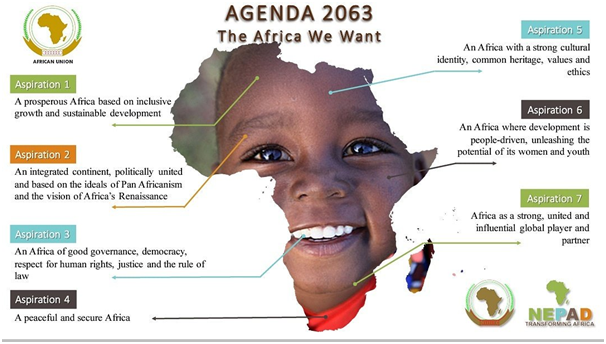
These outputs, along with others, will align with Aspiration 1 and Moonshots 1 to 3 of the Agenda 2063 STYIP, ensuring that the project contributes meaningfully to the continent’s long-term development goals.

Project’s Human Resource Requirements
The team that is expected to work on the project will include the necessary diverse set of skills and experiences to successfully deliver the project outputs. During all stages of the project, the senior staff will oversee the implementation of the project and will be responsible for all project outputs.
The essential human resources required for effective project implementation include:
Project Management
- Project Manager: Oversees execution, timelines, and budgets.
Research and Analysis
- Economic Analysts: Conduct modeling and impact assessments.
- Data Analyst: Manages data collection and processing.
Training and Capacity Building
- Training Coordinator: Organises training sessions and materials.
- Lead Trainer: Develops and delivers economic modeling training.
Administrative Support
- Administrative Assistant: Provides logistical and office support.
- Finance Officer: Manages budgeting and financial reporting.
A comprehensive description of the human resources needed for the project will be detailed in the full proposal.
Timeframe
We estimate that the overall timeframe for the research component of the project will be one year. This timeline accounts for multiple parallel processes that will be conducted simultaneously to carry out various projection activities and produce a range of outputs.
The timeframe for the training component will depend on the final agreement regarding the project’s scope. However, we anticipate that the training of the Member Country teams will be completed well before 2030. This schedule will allow us to ensure that teams are equipped with the necessary skills and knowledge to effectively utilise economic models for policy research and analysis.
Budget Estimate
The budget for the project will be included in the full proposal, which will be developed following the receipt of feedback on this Concept Note. This will ensure that the budget aligns with the project’s objectives and scope and addresses any insights provided by reviewers.